Physics-Informed Neural Networks for Thermophysical Property Retrieval
INFORMATION
In this work, Ali Waseem and I developed a machine learning approach to estimate the thermophysical properties of building walls. Obtaining these properties in situ is challenging: traditional methods for measuring thermal conductivity are often invasive, require prolonged observation periods, or are highly sensitive to environmental variability.
We propose PINN-it, an iterative framework that estimates the thermal conductivity of building facades using thermographic data and environmental measurements. By avoiding invasive procedures and reducing measurement time, this method paves the way toward practical, scalable solution for in-situ material property estimation.
Results
Our experiments demonstrate that PINN-it accurately predicts thermal conductivity when the wall’s initial temperature profile in the simulation is at steady state. The framework’s ability to incorporate real-world environmental conditions—and its robustness across seasons and sampling strategies—highlights its potential as a non-invasive, reliable estimation tool.
When we relaxed the steady-state assumption—simulating initial conditions that did not reach equilibrium, contrary to common practice in both research and in-situ campaigns—the method’s sensitivity to initial conditions became apparent. Despite this, PINN-it still delivered notable accuracy in estimating k, even under non-ideal conditions.
What’s next
- Field campaigns: validating PINN-it on occupied buildings over full seasons, beyond simulation.
- Combining PINN-it with 3D thermal reconstructions (e.g., ThermoNeRF) to move from single-point estimation to full-facade property maps.
- This work is part of the INSULATED project; for collaboration on in-situ measurement campaigns, see Collaborate.
Method
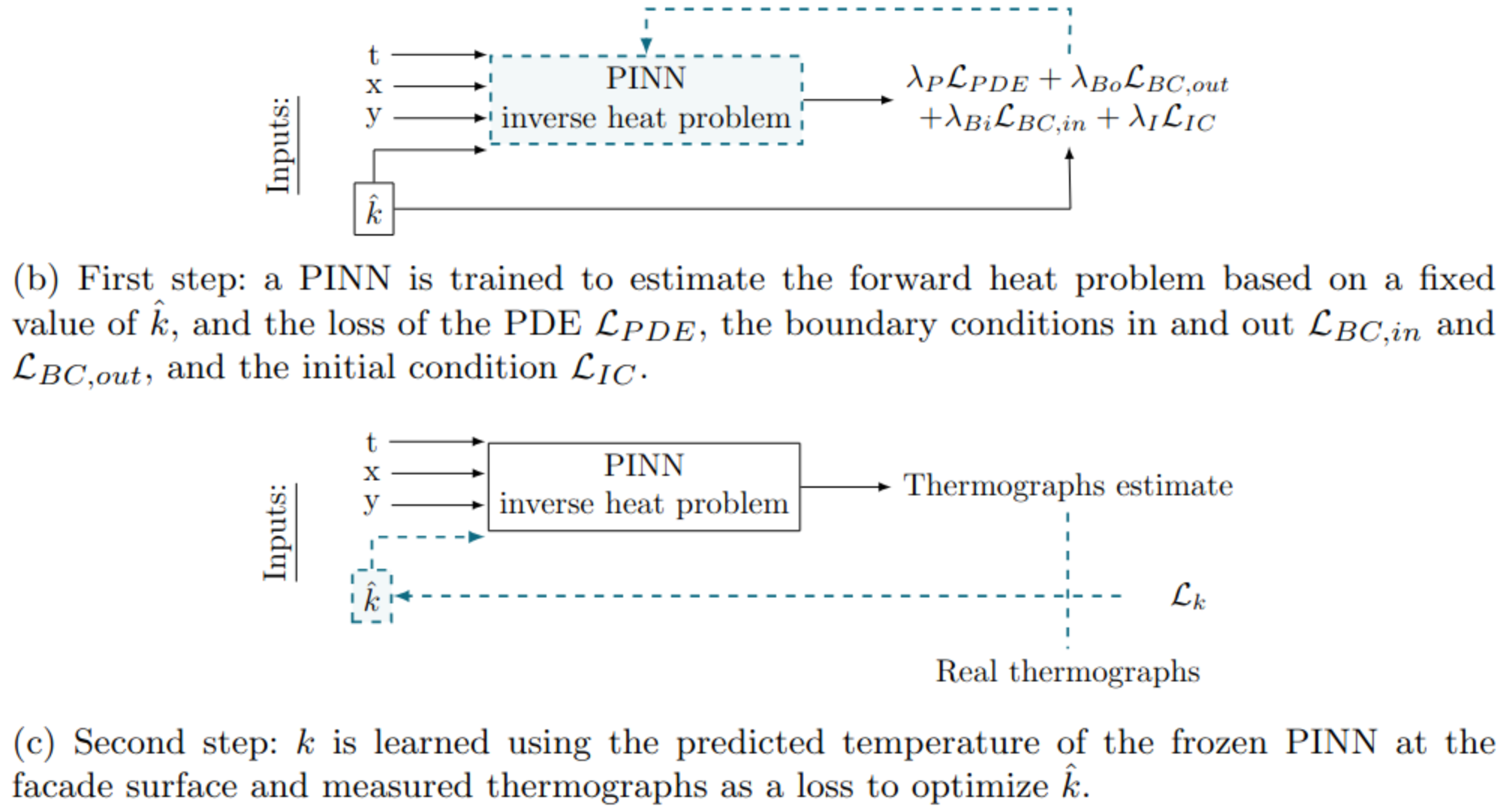
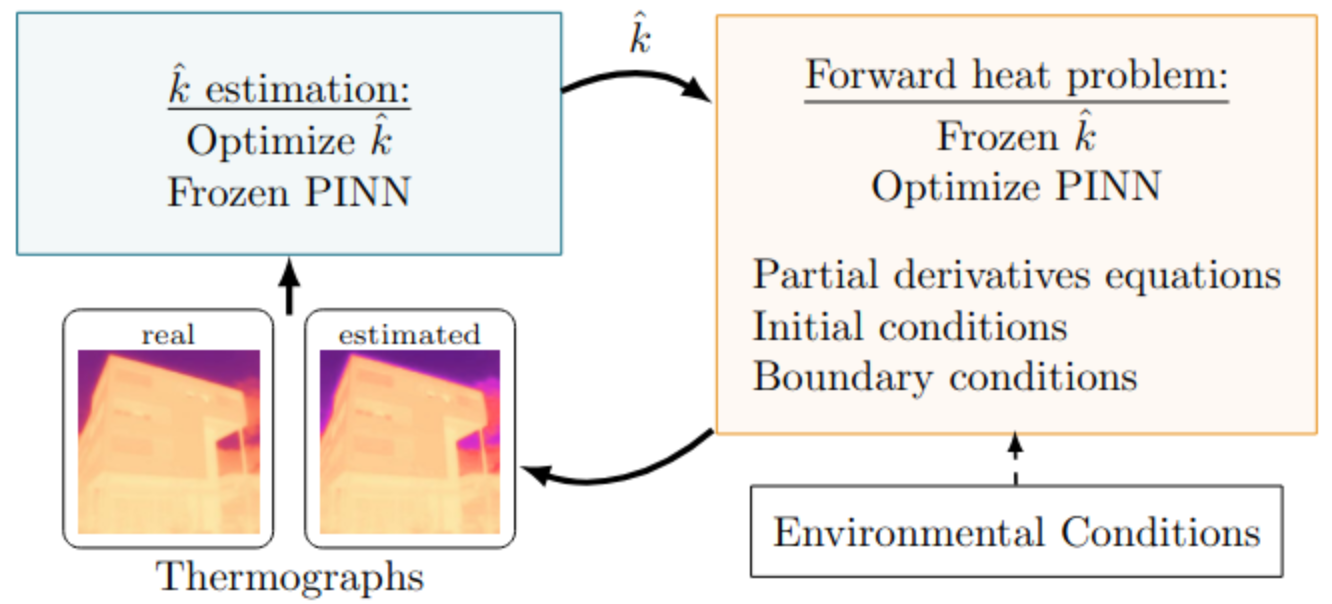
The PINN-it method is an iterative, physics-informed neural network (PINN) framework designed to estimate the thermal conductivity (k) of a building wall from thermographic data. It operates in two alternating steps:
- Forward Heat Problem Learning: A PINN is trained to approximate the temperature distribution within the wall for a fixed estimated conductivity (), using the heat equation, Neumann boundary conditions, and environmental measurements as constraints.
- Conductivity Optimization: With the PINN weights frozen, is optimized to minimize the discrepancy between the PINN-predicted thermographs and real thermographic measurements, repeating until converges to the true material conductivity.